Vitrectomy Surgery
Vitrectomy Surgery
Advanced Micro-Incision Vitreoretinal Surgery (MIVS)
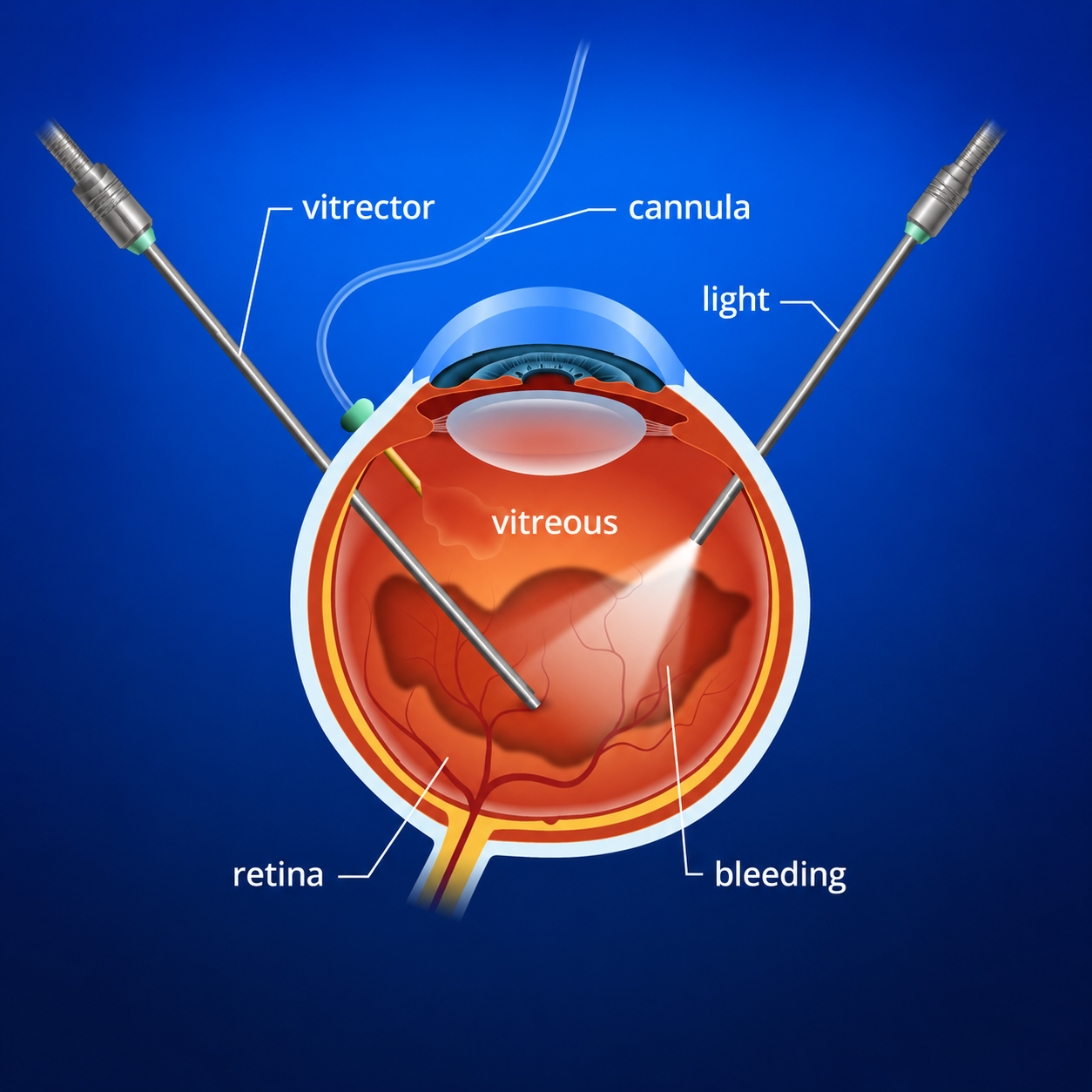
A vitrectomy is a highly sophisticated, delicate microsurgical procedure that involves removing the vitreous gel — the clear, jelly-like substance that fills the center of the eyeball. This surgery is performed to gain access to the retina to treat serious conditions, or because the vitreous itself has become cloudy due to bleeding, infection, or floating debris, blocking light from reaching the retina.
At Dr. Vaidya Eye Hospital, our surgical suites feature state-of-the-art Micro-Incision Vitreoretinal Surgery (MIVS) technology. Using microscopic instruments less than 0.4mm in diameter, our vitreoretinal surgeons perform precise maneuvers to clear hemorrhages, peel macular membranes, seal retinal holes, and reattach detached retinal tissue with outstanding clinical success.
When is Vitrectomy Recommended?
A vitrectomy may be advised when the vitreous or retina is affected by one of the following conditions.
Vitreous Haemorrhage
Bleeding that clouds the vitreous
Diabetic Retinopathy
Advanced diabetic eye damage
Retinal Detachment
Retina lifts away from its base
Macular Hole
A break in the central retina
Epiretinal Membrane
Scar tissue over the macula
Eye Trauma
Injury-related retinal damage
Description & Process
If someone has a lot of blood in the centre of their eye (vitreous gel), they may need a vitrectomy to restore their eyesight. If someone needs vitrectomies in both eyes, they are usually done several weeks apart. Consult Dr. Harshit Vaidya for top-notch Vitrectomy surgery in Mumbai.
A vitrectomy is performed under either local or general anaesthesia. A tiny incision is made in the eye, and a small instrument is used to remove the vitreous gel that is clouded with blood. The vitreous gel is then replaced with a salt solution. Since the vitreous gel is mostly water, there is no difference between the salt solution and the original vitreous gel.
How the Surgery is Performed
Anaesthesia
Local or general anaesthesia
Tiny Incision
A small opening in the eye
Remove Vitreous Gel
Clouded gel is removed
Retina Treatment
Retina repaired as needed
Recovery & Aftercare
One can head home after the procedure, though some people stay in the hospital overnight for observation. The eyes can get red and sensitive, so it is essential to wear an eye patch for a few days or weeks to protect the eye. Medicated eye drops help protect the eyes against infection.
After Your Surgery
Use prescribed eye drops as directed
Wear an eye patch to protect the eye
Avoid heavy lifting and straining
Follow head positioning if advised
Your Follow-up Schedule
Planned reviews help us confirm the retina is healing well after your surgery.
Day 1
First post-op check — the eye patch is removed and your eye drops begin.
Week 1
Healing is reviewed and your activity and positioning guidance is updated.
Month 1
Retinal stability and your improving vision are carefully assessed.
Ongoing Care & Monitoring
This surgery often slows or stops the progression of diabetic retinopathy, but it is not a cure. Since diabetes is a lifelong condition, future retinal damage and vision loss is possible. Even after treatment, a regular eye examination is a must, and at some point additional treatment may be recommended.
Researchers are studying new treatments for diabetic retinopathy that may prevent abnormal blood vessels from developing.
Regular eye examinations remain essential after surgery.
Restore Clarity for Your Eyes
Experience highly advanced, personalized care for Vitrectomy Surgery at Dr. Vaidya Eye Hospital. Book a comprehensive diagnostic exam.